Maha Navonmesh: Wiring Maharashtra's Innovation Money
One pipeline to test, buy and scale deep tech by 2035, on money already earmarked
- Domain
- Public Policy
- Kind
- The Governance Challenge 2026 · submission
- Length
- 30 pp · 1.3 MB
What it found
- 234x
- the ₹2,920 Cr earmark against the ₹12.5 Cr reaching startups as pilot orders
- ₹1,125 Cr
- proposed yearly cost at full run, 52% of the 0.5% earmark
- 90% / 25%
- political salience against system capacity, on the Governance Matrix
Conceive
5 of 18
Research
8 of 18
Test
4 of 18
Fund
7 of 18
Adopt
2 of 18
Scale
3 of 18
How well nine state instruments cover each lifecycle stage, scored out of 18 from the policy texts. Research and funding are best covered; buying what has been tested scores lowest. The scores measure what the texts say rather than what is spent, and are the author's assessment on a stated rule.
Source: Finding 2; the deck's slide 4
Overview
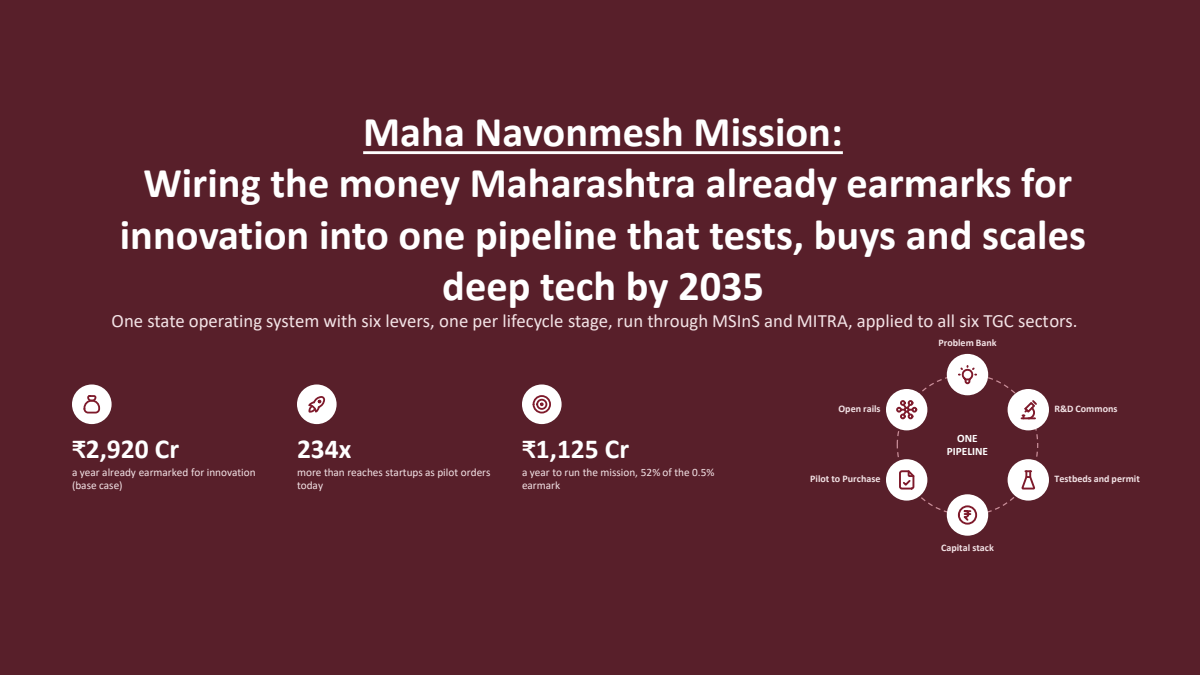
A solution deck for The Governance Challenge 2026: Maharashtra earmarks about ₹2,920 Cr a year for innovation, 234 times the ₹12.5 Cr reaching startups as pilot orders. The proposed mission connects that money into one pipeline with six levers, one per lifecycle stage, run through MSInS and MITRA with no new agency or tax. It costs ₹1,125 Cr a year at full run, 52% of the 0.5% departmental earmark, and is applied to all six challenge sectors. Budget figures are sourced; model inputs and scores are labelled as assumptions or the author's assessment.
Findings
The money exists but has no route. The 0.5% departmental rule gives ₹2,155 Cr and the 3.5% district plan share ₹765 Cr, and pilot orders take 0.4% of that pool
State instruments stop short of buying. Across nine instruments since 2025, stage scores out of 18 are Conceive 5, Research 8, Test 4, Fund 7, Adopt 2 and Scale 3, and pilots stop at ₹25 lakh with the next order needing a fresh tender
The state has will without capacity. It scores 90% on political salience and 25% on system capacity, a Shooting Star on Samagra's Governance Matrix, and the six levers move capacity from 3 to 11 points of 12
Pilot to Purchase is the central rule. Phases run to ₹25 lakh, ₹1.5 Cr and ₹25 Cr, with no fresh tender for the last if verified KPIs are met. 300 feasibility awards lead to 30 scale orders a year, 10% end to end against 58 of 548 (10.6%) at iDEX
The plan is tested against its own limits. With every cost assumption high it runs ₹1,580 Cr, 73% of the earmark. Four of five feasibility tests pass outright; delivery at scale passes only once DGCA and CDSCO agreements are signed